Global E-Cigarette Policy Changes Research Report
2020-2026: A Turning Point from Lax to Strict Regulation
Global E-Cigarette Sales in 2024
22B USD
The global e-cigarette market continues to expand amid policy adjustments, but growth has slowed due to stricter regulations.
Global Regulatory Trends
32
Countries with Full Ban
79
Countries with Partial Measures
United States & North America
Comprehensive Regulatory Upgrade with Significant State-Level Differences
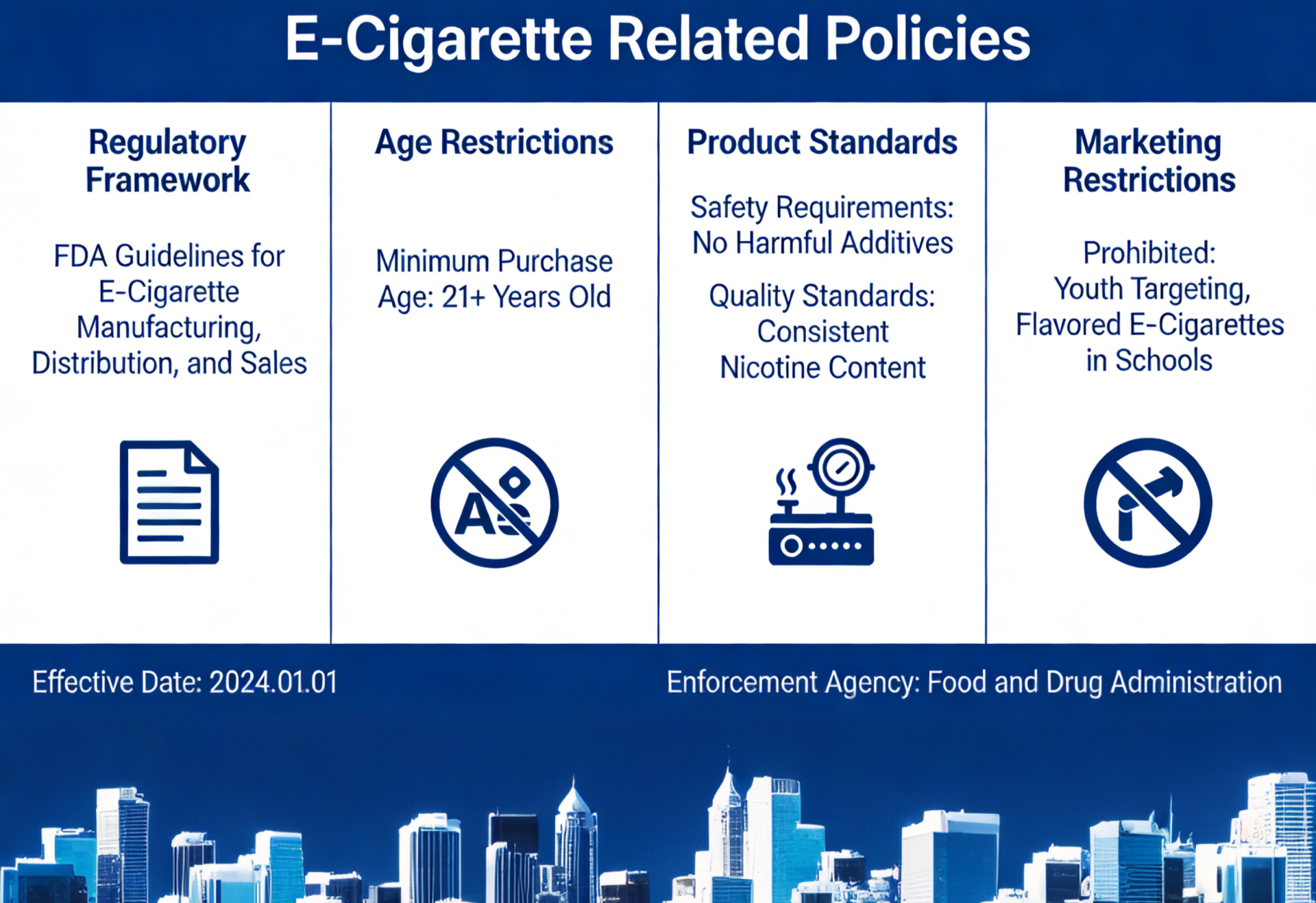
- Federal minimum purchase age raised to 21 (Tobacco 21)
- FDA authorized the first menthol-flavored e-cigarette product (Njoy)
- 34 states tax e-cigarettes, 19 states tax nicotine pouches
- Texas, Wisconsin and other states implemented strict sales bans
EU & Major European Countries
Differentiated Actions Under a Unified Framework
- New Tobacco Products Directive (TPD) implemented in May 2025
- UK, France, Belgium and other countries fully banned disposable e-cigarettes
- UK to introduce e-cigarette consumption tax in October 2026
- Germany implemented an annually increasing e-cigarette tax rate
Major Asia Pacific Countries
Diverse Paths from Full Ban to Strict Control
China
Established a “1+2+N” regulatory system, imposed consumption tax, and canceled export tax rebates.
South Korea
Classified synthetic nicotine e-cigarettes as tobacco products and imposed equivalent consumption tax.
Japan
Purchase age limited to 20 years old, and e-cigarettes are regarded as “tobacco-like products”.
Core Dimensions of Policy Changes
Sales Restrictions
Raised purchase age, banned disposable products, regulated sales channels
Tax Policies
39 countries implemented consumption tax with significant rate differences
Advertising Bans
Comprehensive ban on online advertising, restricted offline display
Health Warnings
Combination of text and images, expanded warning area (50% required in many countries)
Global E-Cigarette Tax Policies
39 countries have implemented e-cigarette consumption tax, of which 82.1% impose specific tax.
Driving Factors of Policy Changes
Health Evidence & Public Health
Increased awareness of health risks, prominent youth use issues, driven by WHO and other international organizations.
Economic Interests & Industrial Impact
Huge potential for tax revenue; South Korea expects to increase revenue by 1.29 trillion KRW in five years.
Political & Social Factors
Political decision-making, social public opinion pressure, international cooperation and coordination.
Future Trend Forecast
- Regulation to Tighten Further
- Tax Policies to Strengthen
- Unified Technical Standards
- Deepened International Cooperation
Conclusion & Recommendations
Summary of Policy Changes
From 2020 to 2026, global e-cigarette policies have experienced a significant shift from lax to strict regulation. Comprehensive bans, higher age limits, increased taxation, strengthened advertising bans, and expanded health warnings have become the five core characteristics of policy changes. Tighter policies have effectively curbed the unregulated development of e-cigarettes, especially achieving positive results in protecting minors.
Core Recommendations
All stakeholders need to actively adapt to policy changes. Governments should establish scientific evaluation mechanisms; enterprises should strengthen compliance management and technological innovation; consumers should fully understand health risks; investors should closely monitor policy trends and seek sustainable development paths under compliance.